Thatcham Surface Water Management Plan Funding Committee Summary Report Of Activities: November 2011 To September 2025
The story of how Thatcham delivered its Surface Water Management Plan over 14 years, turning the lessons of the 2007 floods into lasting protection. It highlights the challenges, partnerships and persistence that secured every scheme, for the benefit of the whole town and future generations.
BACKGROUND
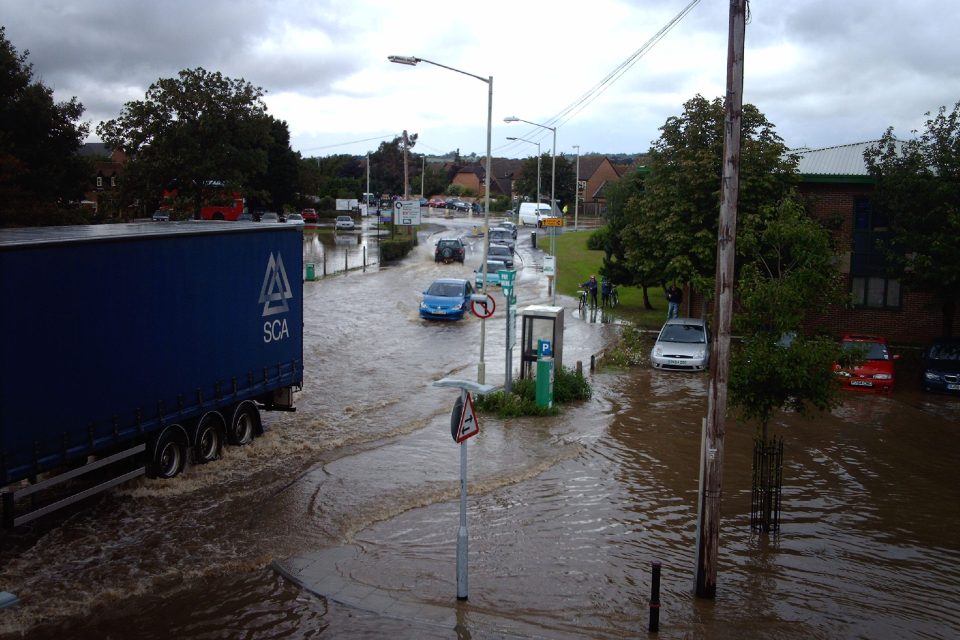
Thatcham experienced a devastating flood in July 2007. In a three hour period about 1200 homes were flooded and three-hour 3000 residents made homeless. The drainage system had been overwhelmed by torrents of surface water running off the hillsides on the NW to NE arc above the town.
There had been many severe flood events across England that day with differing characteristics. This led the Environment Agency (EA) to implement major studies into six flood sites. Thatcham was selected to be one, so that a Surface Water Management Plan (SWMP) could be developed funded by the EA with support from WBC. The newly created Thatcham Flood Forum (TFF) was tasked by Thatcham Town Council (TTC) with supporting this study in combination with relief and recovery work. This study was undertaken by consultants who developed digital models of the flood event that drove the creation of a comprehensive flood defence plan for the town comprising dams, balancing ponds and water flow systems.
In 2010, this SWMP was adopted by both the EA and WBC. It came as a major shock in 2011 when the EA declared that the adopted SWMP was not economically viable. This was unacceptable and at the following TFF meeting it as agreed that I should seek a joint meeting with our M.P., Richard Benyon and the WBC Chief Executive, Nick Carter together with local councils, officers, the EA and, Thames Water. This was held on 22nd September and it resulted in the creation of the SWMP Funding committee which I offered to Chair.
The objective was simple-to get each physical element of the SWMP individually funded and approved, both for design costs and construction capital, and to pursue this until the full SWMP was completed. It was agreed that all the organisations attending the meeting would offer the fullest support. WBC owned the programme and was the only body that could submit plans and funding requests to the EA. The SWMP Funding Committee had no statutory standing as such and worked hand in glove with WBC and TTC. It should be noted that WBC alone handled the financing of landowner compensation and full life maintenance costs of all the schemes. Some 14 years and 71 meetings later the SWMP is physically complete and the Funding Committee has been disbanded.
This report is not a detailed description of each scheme element, but rather is designed to illustrate the many and varied challenges that had to be overcome and the creative steps that were taken to keep the SWMP moving to completion.
SYNOPSIS
From a 2011 perspective, the route seemed straightforward.
All 7 scheme elements from a civil engineering standpoint were essentially earth shifting together with flow control structures inbuilt or separate. The bulk of site work would need to be between April and October each year.
All were either on greenfield sites or on green spaces in the town with no impact on the built infrastructure.
Funding was from only two sources, the EA for capital, dependent on Defra, and WBC for maintenance.
Project approvals were solely in the hands of the EA.
Engineering resource was within WBC being Stuart Clark, in place since 2007.
As we shall see, almost all of these perspectives changed, often in major ways, over the next 14 years. Hindsight reveals three distinct phases.
Phase 1 2011-2014
Very much a learning period for all concerned. In particular the EA approval system and the timing of funding release to local Councils. Also, the need for a nominal level of “ local” funding support to be visible within the business case. So, for the first time we approached both local councils for a contribution, Cold Ash PC £5K and TTC £10k, which they granted.
What emerged, as the first scheme developed (Cold Ash Hill Reservoir), was a four- step process for a scheme :- preliminary design to get funds for detailed design and business case creation, EA regional approval (by July), EA national level approval (once all regions rolled up by October) and funding release by late January. Given the need for Planning approval, letting of contracts and land acquisition the timeline looked to be two calendar years to get on site. That was without any delays that would trigger a redesign or Planning approval issues. Also, the formal funding release date of late January made the appointment of contractors to be onsite by March very tight.
For Cold Ash reservoir we did encounter two delays. An engineering redesign caused by the high water table at the site and then a landowner issue where the landowner requested the scheme be moved North to free up some land that could be built upon. Design commenced in December 2011 and was finally completed by March 2013, with the business case. Funding was released in January 2014 and site work commenced in March 2014.
Learning from this, we could not countenance all schemes following in a sequential train, each 3 years apart. Also, loss of time put project costs at risk and also lack of EA confidence in the ability to deliver on time and budget. So, we requested a degree of parallel working be implemented for the design and business cases of future schemes.
The second scheme Tull Way Reservoir was being worked on from 2012.It too ran into landowner issues, there being three involved, which together with a need for an ecology impact study put us back at least one year.
Finally, preliminary design work on the third scheme, Dunston Park Reservoir, got underway in 2013.
So, by late 2014, after 3 years we had one scheme nearly complete, one expected to go out to tender in 2015 and a third one in the late stages of business case preparation.
Whilst frustrated at unforeseen delays and the lengthy approval cycles, as a team we could feel progress had been made:135 Homes protected, 737 on the way and 117million litres of floodwater capture in sight.
Phase 2 2015-2019
In mid 2014, the funding context changed markedly.
All flood protection bids to the EA now had to show substantial “local contributions” within the business case. If not, the scheme would not be evaluated. Whether this was a false application of the
“polluter must pay” concept was never made clear, nor any clarity on “substantial” amid suggestions this might need to be 30% of capital cost! In essence, suddenly WBC could not submit schemes without these committed “contributions”.
So, the Committee now had an expanded and urgent role :-to raise sufficient money as “enabling funding” for WBC to progress any business case for each of the seven remaining schemes. There was no fundraising experience within the committee members, so we set about creating a compelling and pressing case to sell the need, both in quality and timeliness. We searched for potential major donors/organisations who would support the need for flood protection on this scale for a relatively small town. We decided that we would also go public within 6 months with a clearly defined goal and timescale.
To be clear, this was not an activity that the District Council could undertake itself, however, we received plentiful suggestions from District and Town councillors and the Town Clerk. The campaign was kicked off in Autumn 2014 with an approach to Greenham Common Trust (now Greenham Trust) in a meeting with their recently appointed CEO supported by Stuart Clark from WBC. It was our first pitch and it was well received. However, to that point GCT had never supported projects that were to be funded from the public purse. By presenting the need as “enabling funding” to allow public money to be released, it was taken to the GTC Board and in December 2014 we were awarded £50K of matched funding.
We now had a base on which to build and decided to commit to a public campaign to raise “£100K in 100 days” as the launch message for a press event in March 2015. Whilst we needed a few “big hitters” we also sought contributions for local businesses, individuals and the Waitrose green token scheme. Our M.P., Richard (now Lord) Benyon, lent his enthusiastic support to the launch event, which, to our surprise and thanks to the WBC Communications team, finished up as a report on Meridian TV that evening.
In the runup to this we had approached Berkshire Community Foundation at the suggestion of the Town Clerk and I had opened a promising approach to Scottish and Southern Electricity, which was matched by Greenham Common Trust. TTC had been forthcoming with an offer of financial assistance and the late Roger Croft had pressed for two of the Thatcham District Councillors to dedicate their annual Members Bids to the cause.
It all came together and by July we had commitments for £122K:- from these major sources, two/three small Thatcham businesses, the Burdwood surgery, Waitrose and private donations. The EA were pretty amazed that such a small town could have this level of commitment and so quickly! To the very end of the programme, this achievement carried weight with them in all subsequent project submissions.
Against this backdrop of success, progress on both Tull Way and Dunston Park reservoir schemes were hitting delays and resultant cost escalations. Redesigns and repeat business case submissions driven by landowner requirements together with summer season ecological studies meant lengthy Planning Approval processes (Tull Way 12 months, Dunston Park 24 months). In the case of Dunston Park we encountered a clash with a Developer of a not yet submitted part of the 1250 home NE Thatcham scheme. This was a counter proposal to the reservoir- a graded waterfall style scheme. Whilst impractical, it had been submitted within the Planning process and needed interaction between WBC and a Reservoir panel Engineer to get this eliminated on engineering grounds. More lost time.
Tull Way was finally completed in April 2018, some 5 years since the preliminary design was approved. Dunston Park Reservoir was also facing a delay of one year due to the requirement to do a full field ecology study to identify the presence of voles, bats, dormice and field mice. None were found. It was eventually completed in 2019
By this time, Regional Flood and Coastal Committees, in our case Thames RFCC, were fully developed and had become involved in technical and financial approval of schemes. They were funded by agreed annual levies on all local authorities within their major river catchment and became significant additional funding sources, especially so in the case of Local Authority schemes.
The primary role of the EA continued in terms of evaluation of the design and business case of any scheme, but now funding could be wholly or partly shared between EA Grant in Aid and TRFCC Local Levy grants. Both operated on 5 year rolling programmes and the need to interface with both organisations became vital, especially to ensure that a “bid” for finance for a scheme got regional and national approval within the EA, whilst also pressing the TRFCC to ensure it remained in their program for the local levy element. In the remaining years of our schemes, the TRFCC also introduced their own technical evaluation process. So now, we and WBC had to be fully engaged on both fronts to ensure no further delays got baked in to our plans.
Once again, our focus became how to get acceleration into the approval and construction cycle?
Smaller and simpler engineering schemes involving low level storage ponds, only in use in extreme run off events, were needed at Dunston Green and through the playing fields at Francis Bailey and Kennet schools together with the Agricola Way recreation ground. These would capture other smaller sources of water runoff and provide controlled flow to the surface water sewers through East Thatcham.
How could we get these approved whilst the delayed Dunston Park scheme was being constructed with the resources available? The use of an expanded role for the WBC Consulting Engineer was mooted and the decision taken by WBC incorporate site supervision of construction into their responsibilities. The reality was that the incremental cost was small relative to the potential cost of delays.
It was very timely. These new schemes now impinged to a greater degree on the public sphere and the need for greater community involvement was clear. Examples included presentations to parents at Kennet School, leaflet dropping to affected householders and eventually public drop-in sessions.
The result of the expanded push got the results that we needed. Dunston Green completed in late 2019 and the schemes south of the A4 completed in early 2020. By now, 80% of the properties at risk were protected and 85 % of the 160 million gallons of flood water would be captured.
2020 -2023
Of course, COVID hit. At least Zoom existed so we could continue our meetings. Given the level of anxiety at the time it is remarkable looking back at how much was achieved. The remaining schemes covered three areas. . two schemes in N Thatcham above Bowling Green Rd, two in E Thatcham above Siege Cross estate north of the A4 and the Memorial Field.
Clearly financial approval would be more challenging. These were smaller schemes that protected a smallish number of properties. We only had £22k of local contributions left and a new 6 year EA budget plan starting in 2021 was still in discussion at national level. Given the Covid public spending commitments, it was unclear what that outcome would be. We were determined to get our funding approvals committed for the first three years of this period to derisk the uncertainties of prolonged approvals and uncertain budgets.
Our agreed approach for N and E Thatcham was to get the schemes into 2 bundles. This was pursued and was agreed in principle by the end of 2019 with preliminary designs funded and prepared.
WBC appointed new Consulting Engineers, Ardent, with a further expanded brief that encompassed the complete cycle of design, business case and site supervision. Fortuitously, the Director in charge had been involved in the original assessment and creation of the 2010 SWMP!
Our principal donors were approached. They felt they had done their bit in the past. TTC, once again committed funding, three tranches of £10k. However, £52 K was not going to get the cases approved. We had approached Thames Water (TW) in the past without any result until now. The new Ofwat measurement system for the water companies was to include Partnership Funding with the Local Authorities (in particular Lead Local Flood Authorities) in the next 5 year AMP program commencing in 2021.This was a new venture for TW. We engaged rapidly as our remaining schemes demonstrably interacted with the existing TW surface water sewers through the Town. They had no developed criteria or process for distributing funding, so we offered and got our schemes adopted as pilot schemes for them. Great news: in early 2021 the N and E Thatcham schemes were awarded £25K each. We knew that we now had enough in total to get the business cases through.
Plain sailing? Not quite. No sooner that we had the funding commitments both schemes disappeared from the TRFCC 5 year construction budget program! Our M.P., Laura Farris was asked to intervene and this was most effective. The budgets were restored by April.
This cycle was the quickest yet and funding approval for £2.9m was obtained in December 2021 for use in financial year 2022/23. The Planning Application process had been started in parallel, with a target Approval date of March 2022. Then a totally unexpected obstacle appeared that threatened to derail the whole plan. Both N and E Thatcham schemes were located on potential Housing sites in the emerging Local Plan. In both cases, unbeknown to WBC Engineers, the Developers of these sites had requested delays in the planning process so that they could submit alternative Master Plans to incorporate different versions of these schemes. The risks were clear. Unacceptable loss of time whist the Developers had to go through a rerun EA approval process, lack of certainty that the sites would be Allocated in the final Local Plan, the certain loss of £2.9m of public funds and, crucially, a complete delay in starting the final Memorial Field scheme.
This came to a head at the WBC Planning Committee in March 2022. The WBC engineered schemes were approved subject to conditions which, again, involved an Ecology study that prevented site access before August 2022. So, the whole 2022 construction season was lost. The funding was saved when site clearance started in January 2023 with construction commencing in April and finishing in late 2023.
Tragically, Stuart Clark the principal Engineer at WBC who had been committed to the Thatcham project since 2007 was taken ill in July 2022 and died suddenly in September 2022. He was the lynchpin of the whole project and a full supporter of the SWMP funding committee. Everyone was devastated. A short appreciation was read out at our next meeting and is appended. WBC responded perfectly and never let the project stutter for which we were all most grateful.
The “ring of protection” from the hills on the NW to NE arc above the town were now in place.
“One last Shove” was needed.
Memorial Field 2022-2025
The final scheme was located on the Memorial Field and part of Brown’s Field, the former managed by the Trustees and the latter on land owned by TTC and largely being used by Thatcham Cricket Club. Whilst a vital part of the total SWMP, being needed to protect parts of central Thatcham and the Moor’s Estate to the South, 190 properties in total, it was clearly a sensitive scheme for the owners and users and also the properties on three sides of the site. Anticipating this combined with the delays experienced in previous schemes through the Planning approval system we wanted to know how private Developers managed to avoid the loss of rapid access to sites following Planning permission being granted. The answer was simple with a very significant impact. The process for private major projects was to use the Pre-Application Planning process. This stood the overall process on its head whereby all issues from Statutory Consultees, including internal WBC functions and the public, had to be resolved before the formal Planning Application was submitted and the consultation period commenced. This would be timed to ensure that permission would be granted to enable site clearance to be completed before the nesting season allowing construction to start in April.
The decision was taken by WBC Engineers together with WBC Planning to use this process in April 2022. Experience with hindsight is clear-without this change of approach it would have been unlikely that Planning permission would ever have been achieved on a timely basis to ensure the funding remained available. Effectively, WBC had to become its own “Developer” in planning terms.
This was not a complex engineering scheme although a high water table, groundwater volumes and a strategic oil pipeline were key factors in locating the retention basin and bunds, together with interconnection to the TW surface water sewer. Designs and the business case were completed and approved by late 2022 without any TW funding. However, issues were emerging in WBC meetings with the Memorial Field Trustees and the Cricket Club in particular. For the Trustees, there were real concern over the optimal siting of the “works” and also the level of compensation needed to cover loss of income to the Trust. The retention basin was moved north as far as practicable, necessitating a redesign, and compensation discussions (not related to planning) were ongoing. The Cricket Club needed new professional nets to replace ones lost by the bund to the north and these had to be in place for the start of the 2024 season. This was incorporated into the overall scheme cost. Redesign was completed in time for Public Consultation to commence in June 2023. Important issues regarding Thatcham Tennis club loss of use of courts during construction, alternative provision of the dog exercise area on Brown’s Field and loss of use of public footpaths during construction were predominant.
Finally, with this input acted upon the Pre Planning Application was submitted in September 2023 with final approval needed by February 2024 for immediate access for site clearance. One major objection was raised by Sport England concerning the long term sustainability of cricket on the site.
Negotiations between TTC and the Cricket Club resulted in a new lease, finalised just before the Planning Committee decision meeting which was on 6th March 2024. Planning permission was granted with conditions, including immediate site clearance supervised by the WBC ecologist.
Complete clearance was achieved in short order cleared by the end of March and the contractor was fully onsite in April. Collectively with the support and cooperation of the many interested parties the final scheme was underway in the shortest lead time, being 2 years, and almost £2m of public funds committed to the scheme were secured by a matter of days.
Construction progressed well and to schedule through to October 2024 when serious bad weather intervened and work recommenced in April 2025 with civil engineering completion in September 2025.
So, 14 years after the EA declined to support essentially the same SWMP, all elements were built, 1200 homes now had protection and 160 million gallons of stormwater could now be impounded in an extreme weather event.
Thatcham would stay dry!
SUMMARY
One might ask why this level of effort and commitment was really necessary. Perspectives change over time as does the context of needs and decisions. In 2011, the concept of SWMP schemes to protect urban locations was at a very early point; the Pitt report had only recently lead to the emergence of the Flood and Water Act (2010); Regional Flood and Coastal Committees managing significant budgets from Local Levies had to not yet come about and the financial evaluation process for such schemes were in their infancy. With hindsight, the 2011 situation that WBC found themselves in was as a result of this being an “early adopter” scheme in SWMP terms at National level. Without the benefit of that hindsight, there was no doubt at the time that a way had to be found to get the protection that so many residents needed with house insurance at risk and some still not back in their homes.
As it turns out, with the changes that are outlined in the report, without this independent organisation the District Council would have struggled to find a way for external agencies to raise the local contributions in 2015 that enabled all the remaining scheme elements to be underpinned with “enabling funding”. Additionally, the evolution of this group also provided additional skills, experience and commitment that augmented and complemented the dedicated engineering resources that WBC had at their disposal. The structure of committed meetings every two months, 71 in total, the open and free discussion of obstacles to be overcome and the singular focus on the imperative not to lose time that could mean loss of project financing, ensured creative help and commitment were always to the fore. Whether it was the parallel development of 2 or more schemes, packaging of schemes to enhance business cases, engagement with Thames Water as a pilot scheme, the adoption of a preplanning application methodology to avoid lost construction seasons, this became a concentrated team effort to support the late Stuart Clark, Andrew Reynolds and Jon Winstanley to get the SWMP over the line. Additionally, when the need for political intervention was required, this was freely given by our Members of Parliament on an apolitical basis and to great effect.
At the meeting in 2011 that initiated this approach, Richard Benyon M.P. commented that future generations would look back and ask what the Civic Leaders of this time did when faced with this crisis. I believe all who were involved can hold their heads high by enabling the clearest possible response to be given, “Whatever it took, it was done”.
Brian B Woodham MA, MSc, C Eng (Retd)
Chair, Thatcham SWMP Funding Committee 2011-2025